
There’s something magical about owning or working on a Grade II listed building. The weathered stone, the original timber beams, the sense that you’re custodian of a piece of Britain’s heritage – it’s a privilege that many of us dream about.
But let’s be honest: that privilege comes with responsibilities.
The word “restrictions” might sound daunting, but think of them differently. These aren’t barriers to frustrate you. They’re guidelines designed to protect our shared heritage for future generations. And once you understand them properly, navigating the process becomes far more straightforward.
From our perspective at Terrain Surveys, we see the start of hundreds of heritage projects every year. The ones that run smoothest? They always begin with a deep understanding of the building’s unique character and its legal protections.
So let’s clear up the confusion and get you the answers you need.
What Exactly Is a “Listed Building”?
A building gets listed when it’s deemed to have “special architectural or historic interest” and is considered nationally important. It’s not just about age – though most listed buildings pre-date 1850. It’s about significance.
Historic England maintains the national list for England, and there are three grades you need to know:
- Grade I: Buildings of exceptional interest. Think Buckingham Palace or Canterbury Cathedral. These make up just 2.5% of all listed buildings.
- Grade II*: Particularly important buildings of more than special interest. About 5.8% fall into this category.
- Grade II: Buildings of special interest. This is the big one – over 91% of all listed buildings are Grade II.
Here’s what surprises people: Grade II covers everything from grand Georgian townhouses to modest workers’ cottages. We’ve surveyed listed barns, Victorian post boxes, even 1960s brutalist office blocks. If it tells an important story about Britain’s architectural or social history, it could be listed.
The Core Principle: What the Listing Actually Protects
This is crucial to understand.
The listing protects the entire building, inside and out.
I can’t tell you how many times we’ve heard clients say, “But surely the listing only covers the front?” It doesn’t. Those original floorboards in the attic? Protected. The servants’ staircase you never use? Protected. Even that wonky internal wall you’d love to remove? Almost certainly protected.
But it goes further than that.
Understanding “Curtilage”
This legal term catches many people out. The listing can also protect:
- Later additions to the building (if they’re historically significant)
- Other structures within your property boundary that existed before 1st July 1948
- Garden walls, outbuildings, stables, even historic greenhouse foundations
This is where an initial topographical survey becomes invaluable. It maps out your entire site, including these curtilage structures, ensuring nothing gets overlooked in the planning stage. We’ve seen projects grind to a halt because someone forgot about an old boundary wall that turned out to be protected.
The Golden Rule
You need Listed Building Consent from your local council for any work that could affect the building’s character as a building of special interest.
This includes:
- Demolition (even partial)
- Alteration
- Extension
And yes, “alteration” is interpreted broadly. Very broadly.
Common Restrictions: What You Can and Can’t Do
Let’s get specific about the restrictions you’ll face.
External Alterations
Windows and Doors
This is where most battles are fought. The preferred approach is always repair over replacement. If your sash windows are rattling, the Conservation Officer will expect you to explore restoration first. Draught-proofing, re-cording, even careful splicing of rotten timber – these are all preferable to replacement.
If replacement is genuinely unavoidable (and you’ll need to prove this), it must be done on a like-for-like basis. That means:
- Traditional materials (timber, not uPVC)
- Traditional methods (proper mortise and tenon joints, not modern shortcuts)
- Exact replication of profiles and glazing bars
We recently surveyed a Georgian terrace where one owner had installed uPVC windows without consent. The enforcement notice required complete removal and replacement with timber replicas – at a cost of £35,000.
Roofing
Your choice of materials is rarely yours alone. If the building has Welsh slate, you can’t switch to Spanish slate because it’s cheaper. Clay tiles must usually be replaced with matching clay tiles, right down to the colour and texture.
Even the method of fixing can be controlled. Modern breathable membranes might be brilliant, but if your listed building traditionally used lime mortar and no membrane, that’s likely what you’ll need to stick with.
Extensions
Extensions aren’t impossible, but they must be:
- Subservient to the original building (smaller, lower, set back)
- Of exceptional design quality
- Using materials that complement, not compete
The best extensions we’ve seen are those that are clearly modern but deeply respectful. Think glass links, zinc-clad additions, or carefully detailed brick extensions that reference the original without mimicking it.
External Painting
Even the colour of your front door might be controlled. Victorian terraces often have specific colour palettes that maintain the street’s character. And if someone’s painted original brickwork in the past? Removing that paint will almost certainly need consent – and might not be permitted at all.
Internal Alterations
Layout Changes
Removing walls is where things get serious.
Every historic wall tells a story. That partition between the dining room and parlour? It might seem arbitrary to you, but it represents how Victorian families lived and socialised. Removing it erases that story.
If you’re desperate to create open-plan living, you’ll need:
- A structural engineer’s report
- A heritage impact assessment
- An exceptionally strong justification
Even then, the answer might be no. We’ve seen applications refused for removing walls that would create “an alien sense of space inappropriate to the building’s historic character.”
Historic Features
Here’s what’s protected inside your building:
- Cornicing and ceiling roses
- Original plasterwork (even if painted over)
- Timber panelling
- Historic floorboards
- Fireplaces and surrounds
- Staircases (including the handrail and balusters)
- Original doors and architraves
- Servant bells systems
- Historic kitchen ranges
One client discovered this the hard way when they removed 1920s Art Deco bathroom tiles without consent. The council’s enforcement team required them to source matching vintage tiles from architectural salvage – at considerable expense.
Repairs vs. Alterations: The Critical Distinction

True “like-for-like” repairs might not need consent, but the definition is narrow.
Extremely narrow.
Replacing a broken slate with an identical slate from the same quarry? That’s a repair. Replacing all your slates because some are broken? That’s likely an alteration requiring consent.
Repointing brickwork using the exact same lime mortar mix and pointing style? Possibly just maintenance. Using modern cement mortar because it’s more durable? Definitely needs consent (and will likely be refused).
Our advice is always: if in doubt, check with the local council’s Conservation Officer. It’s a conversation that can save you significant time and money. They’d rather hear from you before you start work than discover unauthorised changes later.
The Consequences of Getting It Wrong
Let’s not sugar-coat this.
Carrying out unauthorised works to a listed building is a criminal offence.
The penalties include:
- Unlimited fines (yes, unlimited)
- Up to two years in prison
- Being forced to reverse the changes at your own expense
- A criminal record that could affect your career and travel
We know of one developer who gutted a Grade II listed farmhouse without consent, thinking
he’d seek forgiveness rather than permission. The court fined him £450,000, and he had to rebuild the interior using traditional methods and materials. The project that should have cost £200,000 ended up costing over £1 million.
The Correct Process: How to Do Things Properly
Here’s your roadmap:
1. Get Early Advice
Contact your local Conservation Officer before you even start sketching ideas. Most are passionate about helping buildings evolve sympathetically. You can find out more about their role from the Institute of Historic Building Conservation (IHBC). A pre-application meeting costs around £150-£300 but could save you thousands.
2. Commission Professional Surveys
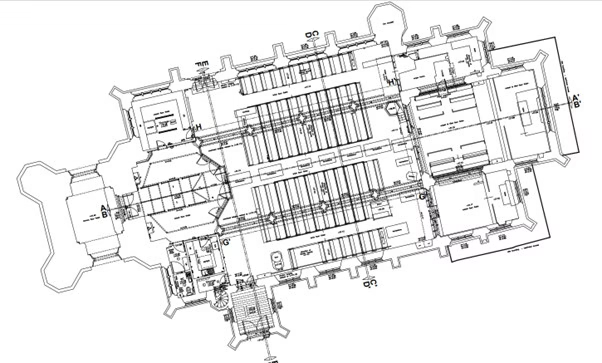
This is where we come in. An accurate measured building survey provides the essential detailed floor plans, elevations, and sections required for any Listed Building Consent application.
For homeowners, it gives you a true understanding of what you own. Those detailed drawings allow you and your architect to plan sympathetic changes that respect the building’s heritage while meeting your needs.
3. Appoint Experienced Professionals
Work with an architect or planning consultant who has the specific certification in conservation, and strong past experience in heritage buildings. Yes, they cost more than generalists. But they’ll save you money in the long run by getting your application right the first time.
4. Submit a Detailed Application
Your Listed Building Consent application needs:
- Detailed drawings (this is where that measured survey proves invaluable)
- A Heritage Statement explaining the building’s significance
- A Design and Access Statement justifying your proposals
- Often, specialist reports (structural, ecological, archaeological)
The process typically takes 8-13 weeks, though complex applications can take longer.
Your First Step: Why a Measured Building Survey Matters
Here’s something we tell every client: you can’t protect what you don’t understand.
A professional measured building survey isn’t just about compliance – it’s about discovery. We regularly uncover features that owners didn’t know existed. Hidden fireplaces behind modern plasterboard. Original beam structures above suspended ceilings. Tudor wall paintings under Georgian panelling. These discoveries can completely change your project’s direction – for the better.
Our 3D laser scanning technology creates what we call a “digital twin” of your building. Every moulding profile, every subtle lean in an ancient wall, every quirk that makes your building unique – it’s all captured with millimetre accuracy.
For architects and developers, this means:
- Accurate feasibility studies
- Detailed drawings that satisfy planning requirements
- Clash detection before construction begins
- A permanent record for future reference
For homeowners, it means:
- Understanding your building’s true potential
- Avoiding costly mistakes
- Faster planning approvals
- Peace of mind that nothing’s been overlooked
The survey also identifies those special features that make your building “listed” in the first place. Once you know what’s historically significant, you can plan changes that enhance rather than compromise your building’s character.
The Bottom Line
Yes, Grade II listing comes with restrictions. But they’re not insurmountable barriers – they’re guidelines for good stewardship.
With the right team and proper preparation, working on a listed building becomes incredibly rewarding. You’re not just creating a home or completing a development. You’re adding your chapter to a story that’s been unfolding for centuries.
The key is starting with knowledge. Understanding your building. Respecting its history.
Planning changes that enhance rather than overwrite this history.
Whether you’re a homeowner planning a kitchen extension or an architect starting a major conversion, the principles remain the same. And it all begins with truly understanding the building you’re working with.
Ready to Start Your Listed Building Project?
If you’re planning any work on a listed building, our team is here to provide free, professional advice on the survey requirements for your project.
We’ve been helping owners and developers navigate listed building projects since 2004. Our ISO 9001:2015 accreditation and membership of The Survey Association means you’re working with true professionals who understand both the technical and heritage aspects of your project.
Contact us today for a free, no-obligation quote for a detailed measured survey.
Once you have your highly accurate measured building survey from us, you’ll be well placed to hand it over to your conservation architect, who will be able to formulate the next chapter in the building’s life, carefully and respectfully.
Because every listed building deserves to be understood, protected, and thoughtfully adapted for modern life.