

Your property almost certainly had plans at some point. An architect drew them, the council approved them, and a builder worked from them. But here’s what most homeowners don’t realise: those plans are unlikely to reflect your property as it stands today. In fact, they probably never were accurate to begin with, because what is built during construction is almost never identical to what the architect designed.
So if you’re searching for your property’s original plans because you’re planning an extension, loft conversion, or refurbishment, you should stop, and seriously consider getting a new set of plans done instead.
But if you just want the plans for some non-official project, I’ll walk you through where to look, what you’ll realistically find, and what to do when those plans fall short.
Why You Might Need Your Original Building Plans
The most common reason people go looking for building plans is because they’re planning an extension, renovation, or loft conversion. That’s the point you need accurate and reliable spatial data for design and planning work.
Usually, it’s your architect who tells you they need accurate drawings before they can start designing. And that’s when most homeowners discover the problem.
Here’s what you need to understand: planning permission and building regulations are two separate systems. Both may require accurate, up-to-date drawings of your property. Not old plans that are less than 100% accurate.
The only sure-fire way to get accurate, up-to-date plans, suitable for construction, is to commission a survey. More on that below.
When Plans Are Legally Required
Building regulations approval is needed for any loft conversion creating habitable space, new extensions, and structural alterations. This applies even if your project falls under permitted development.
Planning permission requires accurate drawings submitted with your application. Listed buildings always require consent for alterations, with no permitted development rights.
The trap? Just because your project qualifies as permitted development does not mean you can skip documentation. Building regulations still apply.
For general curiosity, insurance, or a rough idea before speaking to a builder, old plans are a useful starting point. But for actual design, planning, or construction work, you’ll need something far more accurate.
Where to Look for Existing Plans
Here are the main places to check. Just keep your expectations realistic.
Your Own Records and Sales Documents
Start with what you already have: leaseholder packs, mortgage survey reports, estate agent sales particulars, and your conveyancer’s files. If you bought a new build, the developer may still hold plans. Previous owners may have copies too; your solicitor can help you make contact.
One caveat. Estate agent floor plans are indicative layouts, not measured drawings. They give you a rough idea of the property layout, but they are not accurate enough for planning applications or design work.
Council Planning Portal and Building Control Records
Every local authority in England and Wales has an online planning portal. Search by address or application number. This is your best bet for finding submitted plans from previous extensions or alterations.
Building control records are separate and often held by a different department, so check both.
But here’s what most people miss: councils don’t keep all planning records forever. Retention policies vary significantly by council and document type. Some councils, such as Dudley Council, retain detailed application files for only 15 years from the decision date, after which only basic application information is kept. However, key documents like approved plans, building control completion certificates, and structural calculations are often retained for the life of the building. Always check with your specific local authority, as it is always worth asking. Pre-1948 planning records and pre-1974 building control records may not exist at all. Pre-1980s records are often poor quality, on microfiche, and may require an in-person visit.
Land Registry (Not What You Think)
This is where a lot of homeowners get confused.
Title deeds are indicative at best and not fit for purpose when it comes to detailed design work or understanding exactly where your boundary is. Title plans show general land boundaries on an Ordnance Survey base map at 1:1250 (urban) or 1:2500 (rural) scale, using the “general boundaries rule.” The red line is approximate, not precise.
They do not show internal layouts, room dimensions, or anything you’d need for building work.
Lease plans (for flats and leasehold properties) show the extent of the leased area but are not measured building surveys either.
Historic England Archive (Listed and Pre-War Properties)
If you own a listed building or a pre-war property, the Historic England Archive holds files on over 70,000 individual buildings, including more than 56,000 architectural drawings (Historic England, Archive Collections). Over 1 million records are searchable online for free, with the physical archive in Swindon available by appointment.
Local Archives and Other Sources
County record offices and local history libraries sometimes hold architects’ drawings and building plans. For very old properties, fire insurance maps from the 1800s can provide building footprints. Check whether the original architect or builder is still trading. And if you live in a terrace or estate-built development, a neighbour with a mirrored property may have plans.
Why Existing Plans Are Rarely Enough
Even if you do track down old plans, they are almost certainly not accurate enough for professional design or planning work.
100% of residential surveying projects need a professional measured survey before starting any kind of building project because any “original” plans will simply not be accurate and not fit for any design or planning work.
That might sound bold. But consider this.
Buildings change over time. Extensions get added. Walls get moved. Rooms get knocked through. We surveyed a multi-tenanted office block where the recorded floor area on the existing plans differed by 10 to 15% from what we actually measured. That had a direct bearing on rent reviews and service charge apportionment.
Even new builds should have an as-built survey. A building is never built to the exact measurements of the design, and there are often changes and modifications both during the original construction and over time.
The bottom line? Finding old plans is useful for context. But for any extension, renovation, or construction project, you need a professional measured survey that captures your property as it actually is today.
Getting a Professional Measured Survey
What You Get
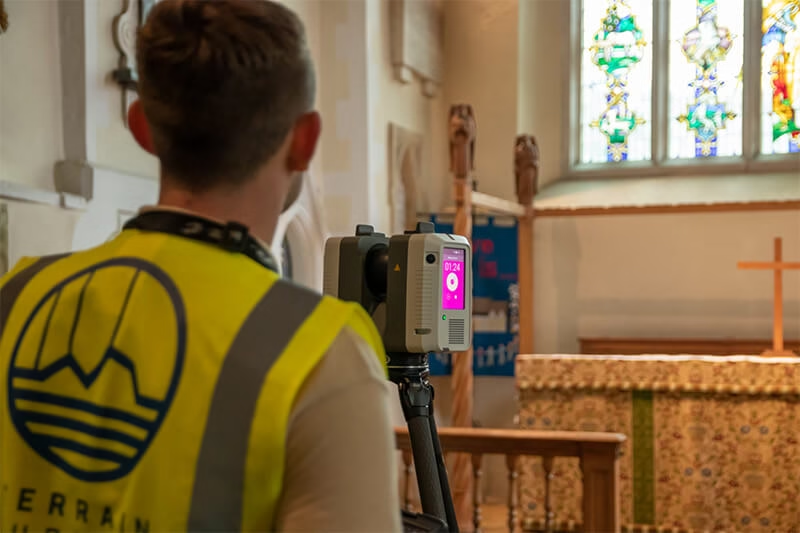
A measured building survey captures your property as it stands right now. You receive accurate floor plans, elevations, sections, and roof plans to specified tolerances, delivered as CAD drawings or PDF. For more complex projects, 3D Revit models are an option.
The survey is the foundation of your project. Cut corners here and you risk expensive mistakes further down the line.
How Long It Takes and What It Costs
For a typical 4-bedroom detached house, we’re on site for 3 to 4 hours and generally issue final deliverables within 5 working days: topographical survey, floor plans, elevations, and sections.
On cost: a typical 3-bedroom semi costs circa £1,200 including topographical survey, floor plans, and elevations. Higher detail levels (sockets, reflective ceiling plans, sections) increase the price. A professional survey typically costs 1 to 3% of a typical extension budget.
Common Mistakes That Cost You More
Mistake 1: Relying on inaccurate plans or DIY measurements.
Trying to save around £1,000 with a DIY survey can cost 10 to 100 times that saving if inaccuracies go unnoticed into the later stages of a build. If DIY measurements worked for professional purposes, there would be no need for surveyors.
We surveyed a Grade II listed farmhouse where the as-built dimensions were 200mm out in several critical locations, versus the original architects drawings. The new architect had components being manufactured off-site to measure. Without our survey, those would have been wrong.
We’ve also seen clients miss planning deadlines because the need for a survey was overlooked, even though it’s a requirement of the planning authorities, forcing resubmission at additional cost and significant delay.
Mistake 2: Getting a partial survey to save money.
This is the most common mistake we see on residential properties. The homeowner surveys only the area they’re currently working on.
It rarely works out. We’ve had clients instruct a partial survey to save a couple of hundred pounds, only to come back a month later for the full survey. The result? Nearly double the cost of what the original full survey would have been.
The piecemeal approach always costs more because initial costs are weighted towards mobilisation and site surveying. Get the full survey from the start.
How to Choose a Surveyor You Can Trust
Check The Survey Association (TSA) website for affiliated and verified survey companies. Look for ISO 9001 quality registration and industry accreditations like Constructionline Gold, CICES, and CSCS.
Ask about deliverable formats and tolerances before you commission work.

Be cautious about extending another company’s survey. The only way to check whether a previous survey is accurate is to re-measure it. In most cases, starting fresh is easiest and most cost-effective.
Terrain Surveys is accredited by ISO 9001, Constructionline Gold, CICES, TSA, CSCS, and Acclaim. Established since 2004 with 4 offices across England, we cover projects throughout England and Wales.
What to Do Next
Your building plans probably aren’t “missing.” They may well exist in a council archive or a solicitor’s file. But for any professional design or construction work, they won’t be accurate enough to rely on.
A professional measured survey gives you everything you need: accurate floor plans, elevations, and topographical data your architect can work with. Don’t cut corners at the foundation of your project.
Need Accurate Building Plans?
Get a free, no-obligation quote for a professional measured survey of your property.
Get a free, no-obligation quote from Terrain Surveys. Call +44(0)143 884 1300 or request a quote.


