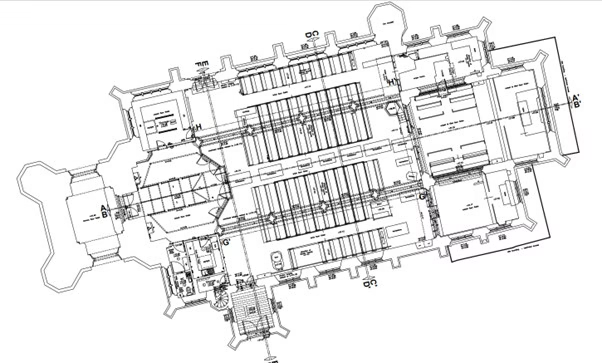

Most area referencing problems don’t start with bad measuring. They start with two wrong assumptions: that the existing plans are accurate, and that any old floor area will do. Get either wrong and a deal can stall, a rent can be mispriced, or a valuation can be challenged.
Area referencing is simply the process of measuring and classifying the floor area of a building to a recognised standard, so everyone relies on the same numbers. Let me explain how it works, which standard you actually need, and where it tends to go wrong.
What area referencing actually is
At its core, area referencing turns a building into a defensible set of numbers. A schedule of areas, backed by measured plans, that a valuer, agent, landlord or tenant can all trust.
In the UK those numbers are usually expressed three ways. Gross External Area (GEA), measured to the outside of the external walls. Gross Internal Area (GIA), measured to the inside face of the external walls. And Net Internal Area (NIA), the usable space an occupier actually gets, with structure, stairs, lifts, plant rooms and permanent corridors stripped out (RICS Code of Measuring Practice).
Same building. Three very different figures. That’s exactly why specifying the right one matters.
GIA, NIA and GEA: which one do you actually need?
Here’s the thing: each measure answers a different question.
- GEA is typically used for planning applications, council tax banding and rough build-cost estimates.
- GIA is the basis for valuing industrial units, warehouses and retail sheds, and for estimating construction costs.
- NIA is what matters for offices and most lettings, because it reflects the space a tenant can actually use and pay rent on.
The most common confusion we see is people not understanding the difference between NIA, GIA and GEA in the first place.
It usually happens because the person buying the survey has been handed a procurement task without the project scope. They’ve been told to get costs, not told what the data is for.
So our approach is always the same. We have a conversation to clarify exactly what’s needed and who’ll be using the data. More often than not that means speaking to the person who’ll actually use the figures, which lets us quote on precisely the right deliverable from the outset.
IPMS and the changing standards landscape
For years, the RICS Code of Measuring Practice was the reference for everything. That’s been shifting.
From 1 May 2018, the RICS Property Measurement professional statement (2nd edition) was mandatory for RICS members measuring offices and residential buildings, requiring the use of the International Property Measurement Standards, or IPMS. IPMS: All Buildings then arrived in January 2023 as a single consolidated standard covering every building type. That earlier professional statement was archived by RICS in June 2025; RICS members now adopt the appropriate measurement basis from either IPMS: All Buildings or the Code of Measuring Practice, depending on property type.
Did You Know?
IPMS maps onto the old language fairly neatly. IPMS 1 is broadly like GEA, IPMS 2 like GIA, and IPMS 3 like NIA. But for industrial, retail and mixed-use buildings the traditional Code of Measuring Practice (6th edition) still applies, and RICS has indicated that a consultation for the 7th edition is due in Q2 2026, with a new edition expected later in 2026.
Source: RICS, International Property Measurement Standards (2023) and RICS, Code of Measuring Practice (2025)
Which standard applies depends on your building type and your purpose. That’s not a detail to guess at.
Is the market actually moving to IPMS? In our experience, slowly but surely. The standard request is still the traditional GIA/NIA deliverable, but IPMS schedules have grown over the last few years, especially on larger commercial projects.
In the last 12 months, roughly 30% of our area referencing enquiries have specified IPMS.
Why getting the area wrong costs real money
This is where it stops being academic.
IPMS deliberately includes areas that NIA excludes, such as columns and an occupier’s share of party walls. So IPMS will almost always produce a higher figure than NIA. In one worked example, a 10,000 sq ft office under NIA became 10,500 sq ft under IPMS: a 5% uplift, which at the same rent per square foot pushed annual rent from £300,000 to £315,000 (Cushman & Wakefield, 2023).
Now flip that round to the most common error we see in practice.
A client who had acquired a shopping centre in London had several vacant units and was negotiating leases with new tenants. To agree terms, both sides needed accurate areas to calculate rentable value. Neither party would proceed without assurance they weren’t being over- or under-charged.
The trouble? The only plans were the original design drawings. Outdated and inaccurate.
They showed the vacant units as one large open space, but over the years it had been sub-divided into smaller units, so no accurate plans existed.
We were commissioned to carry out an as-built measured survey of the units, including GIA and NIA calculations. That gave both parties reliable numbers, and the deal went ahead.
It’s far from unusual. When a building hasn’t been professionally measured, the figures in property particulars or lease documents often differ from reality.
Design plans get used as the basis for area calculations even though they were never checked against what was built. And a building always varies from its design during construction, so basing areas on outdated drawings is asking for trouble.
When to commission area referencing, and who needs it
What pushes someone past a basic measured survey to detailed area schedules? It varies by sector, by buyer and by where the asset is in its life cycle.
Property owners and managers tend to come to us around lease negotiations and valuations, where accurate areas protect their return on investment. Facilities and estate managers usually have a different driver: space planning and logistics, where knowing the real usable area shapes everything from desk counts to fit-out.
The biggest mistake to avoid
The single biggest mistake property professionals make is assuming accurate, up-to-date plans already exist. They rarely do.
That assumption is what turns a routine job into a panic. Suddenly an urgent survey is needed so the deal doesn’t collapse, because no tenant will price rent off information they don’t trust, and no owner should either.
So before you commission, work through this:
- Confirm the purpose, whether valuation, leasing, planning or space planning, before anything else.
- Pin down the standard required (IPMS, GIA, NIA or GEA) for your building type.
- Don’t assume existing drawings are accurate. Treat them as a starting point, not a source of truth.
- Speak to whoever will actually use the figures, not just whoever is collecting quotes.
- Build in enough time. Leave it to the eleventh hour and you’ll pay for the rush.
Key Takeaways
- GEA, GIA and NIA give very different figures for the same building, so specifying the right one is critical.
- RICS archived its Property Measurement professional statement in June 2025; RICS members now select the appropriate standard from IPMS: All Buildings or the Code of Measuring Practice depending on property type.
- IPMS almost always produces a higher figure than NIA, which directly affects rentable value.
- Never assume existing plans are accurate. Outdated design drawings are the most common cause of last-minute surveys.
Get your area referencing done right
Accurate areas are the foundation everything else is built on. A valuation, a lease, a space plan, a transaction. As a multi-discipline survey practice working across England and Wales, we produce measured plans and area schedules to the standard your project actually needs, with a clear conversation up front so you commission the right thing once.
Need Accurate Area Referencing?
Get a free, no-obligation quote from our experienced surveying team.
Terrain Surveys provides measurement and survey data only. We do not provide property valuation, rating or legal advice; for those you should consult a RICS registered valuer or a solicitor. Terrain Surveys works to RICS standards and is accredited by ISO 9001, Constructionline Gold, CICES, TSA, CSCS and Acclaim, but is not directly regulated by RICS.