
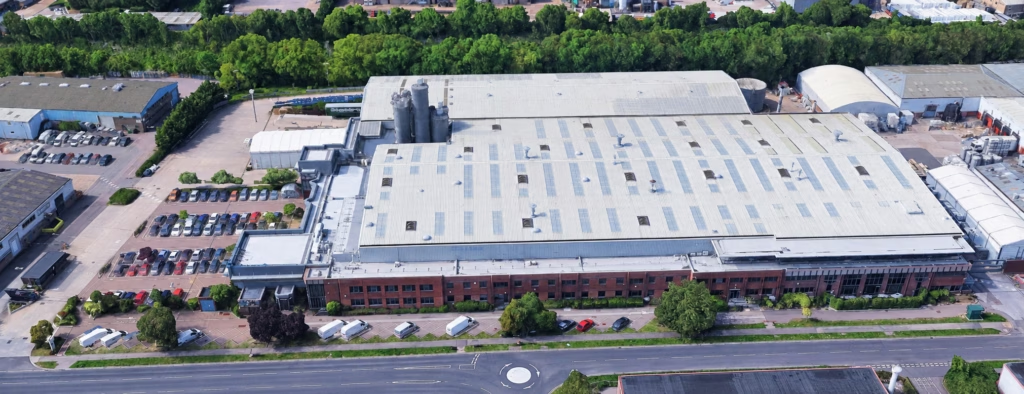
More Than a Survey: Helping Altro Build a Complete Picture of Its Letchworth Manufacturing Site
Overview
When Altro Flooring first approached Terrain Surveys, the initial enquiry appeared relatively straightforward: the team wanted to understand and map the underground services at its manufacturing site in Letchworth.
But after speaking with Altro, it quickly became clear that the real requirement was much broader.
The business was considering future development of the site but was working with limited and outdated information about its buildings, external areas and below-ground infrastructure. Before making significant decisions around the estate, Altro needed an accurate current-state picture of what it already had.
Rather than simply pricing the survey originally requested, Terrain took a consultancy-led approach: understanding what Altro was ultimately trying to achieve, identifying the information it would need to get there, and developing a coordinated programme of surveys around the way the site operated.
By bringing topographical, measured building, utility and CCTV drainage expertise together through one surveying partner, Terrain was able to provide Altro with a comprehensive, coordinated set of site information – while managing the project, logistics and deliverables from beginning to end.
The Challenge: Understanding the Site Before Planning What Comes Next
Altro has occupied its Letchworth manufacturing site since 1988, having taken over an existing industrial facility.
Over time, the site had evolved around its manufacturing operation. However, much of the historic information available to Altro was limited, with some records consisting of old paper drawings and little reliable information about how infrastructure connected across the estate.
For Darren Gray, European Project Engineering Manager at Altro, this presented a clear problem as the company began considering future development.
“Without knowing what we’ve got, it’s very difficult to plan ahead.”
The consequences of making decisions without that information could be significant.
Altro operates large-scale production equipment and infrastructure. One of the examples Darren highlighted was a 16-metre silo capable of holding approximately 90 tonnes of material.
“The last thing I wanted to do was add another silo, for instance, above a collapsed drain or a void that we weren’t aware of. We really needed a lot of information about the site to give us that current-state picture.”
Altro therefore began approaching surveying companies to establish what information could be captured.
Looking Beyond the Initial Brief
The original enquiry received by Terrain asked primarily for the site’s underground services to be mapped and was accompanied by an old site plan.
Terrain could simply have quoted for that requirement.
Instead, Graham King from Terrain’s consultancy team contacted Altro to understand the bigger picture.
The first question was not simply what survey do you want?, but what are you ultimately trying to achieve?
Through those conversations, Terrain established that Altro was not simply trying to locate underground services. The company wanted to understand the site as a whole so it could assess development opportunities, make better use of existing space and manage its assets more effectively in the future.
That changed the conversation.
A utility survey alone would provide only part of the information Altro needed. Before underground information could be accurately coordinated, an up-to-date topographical base survey was required. Measured building information was also needed to understand the existing buildings, while CCTV drainage surveying would provide information about the condition and connectivity of the drainage network that utility mapping alone could not supply.
As Graham explained:
“We could have priced what they’d asked for and just sent it to them. But it was clear they needed some help in understanding what they actually needed.”
The aim became not to sell Altro an individual survey, but to provide the right combination of information to answer the wider question behind the original enquiry.
Consultancy Before Anyone Arrived on Site
Once the wider objectives had been established, Terrain arranged a site meeting with Darren and the Altro team.
For a large manufacturing environment, this was an important part of developing the survey strategy.
Altro’s Letchworth facility operates 24 hours a day, five days a week, with manufacturing processes, chemical handling, HGV movements and restricted areas that could not simply be interrupted to accommodate survey teams.
Walking the site together allowed Terrain and Altro to discuss where surveyors could work during normal operations, where access would be restricted, what would need to be completed out of hours and how the different survey activities could be sequenced.
This included extending elements of the topographical survey beyond the immediate site boundary so that information relating to surrounding carriageways and access could be captured with future development in mind.
Rather than discovering these issues after mobilisation, they could be built into the survey programme from the outset.
For Graham, that site meeting was also the point where the relationship moved from a conventional tender exercise towards a genuine partnership.
“You could feel the trust building. It was two-way dialogue. We were reassuring them that we were going to be a survey partner – not someone simply coming in and saying, ‘this is what we’ve got to do’.”
This approach was noticed by Altro.
Darren explained that several other companies involved in the tender process had provided relatively formal budget proposals, with little further engagement.
Terrain took a different approach.
“Terrain Surveys was one of the few that proactively reached out, asked a few more questions and wanted to know a little bit more about what was going on.”
That became an important factor in Altro’s decision.
“Terrain Surveys weren’t the cheapest, but they provided a lot more things that ticked the boxes that we needed.”
One Surveying Partner. One Coordinated Picture.
The project also demonstrated the value of Terrain’s multi-disciplinary, in-house approach.
Building a comprehensive understanding of a complex site requires several different surveying specialisms. But those surveys cannot always be treated as completely independent pieces of work.
The topographical survey provides the accurate base to which building, utility and drainage information can be coordinated. The different datasets need to align spatially, and the teams carrying out each stage can uncover information that affects the teams following them.
Because Terrain manages these disciplines in-house, the survey programme could be coordinated as one project rather than Altro having to manage several independent suppliers.
This proved particularly useful during the work.
Information identified by Terrain’s utility team could be passed directly to the drainage team before they reached particular areas of the site. Where difficult covers, root ingress or other drainage issues were identified, Altro could be alerted immediately and decisions made while other survey work continued.
This flexibility reduced the risk of a specialist team arriving on site only to find that an area could not be surveyed, losing a day and then requiring a separately charged return visit.
It also meant responsibility for bringing the different datasets together remained with Terrain.
For Graham, that is an important distinction when organisations require several survey types:
“The fact that we can do it all in-house means that we’re managing everything. We’ve got full control of our resources, timeframes and deliverables, and if any issues crop up, we can deal with it holistically.”
The result for Altro was one coordinated surveying partner, rather than several separate suppliers producing information that then needed to be managed and reconciled internally.
Delivering Information Altro Could Actually Use
Terrain’s consultancy approach also influenced the deliverables.
Modern surveying technology can produce highly detailed point clouds, 3D models and extensive datasets – but the most sophisticated output is not necessarily the most useful one for every client.
During the early meetings, Terrain asked an important question:
Who is actually going to use this information, and how will they use it?
Altro did not have the internal capability or requirement to routinely manipulate large Revit models or complex point-cloud datasets. Providing those outputs simply because the technology allowed it would have added complexity without necessarily adding value.
Instead, Terrain worked with both Altro’s project engineering and facilities teams to establish the formats they would actually use.
The primary information was therefore delivered in practical 2D formats, while Terrain retained the underlying 3D point-cloud data so that further outputs could be created in the future if Altro’s requirements evolve.
The consultancy continued after the initial drawings were issued.
When Altro’s Facilities team wanted the ground-floor internal building information displayed alongside the external topographical information, Terrain adapted the drawings accordingly. The team also remained available to talk through utility and drainage information, explain findings and discuss which drainage issues required immediate action and which could be addressed later.
The objective was not simply to hand over survey files.
It was to make the information genuinely useful.
Supporting Altro Through the Survey Process
For Altro, some elements of the project – particularly the detailed drainage investigation – were unfamiliar.
Terrain therefore worked closely with Darren and the Facilities team throughout the programme, explaining what would happen, what access was required, where uncertainties existed and what potential additional work might be needed if problems were uncovered.
Darren described this support as an important part of the experience:
“The team here were really pleased with the planning and scheduling work that went in. Everything was proactively shared.”
And in areas where Altro had less previous experience:
“It was really kind of a hand-holding and handshaking as we went through, which was really appreciated.”
The Result: A Starting Point for Future Development
The completed survey programme has given Altro something it previously lacked: a detailed, coordinated current-state picture of its Letchworth site.
It has also identified areas requiring further attention, including root ingress and damaged sections within the drainage network.
Rather than these findings being viewed negatively, they provide Altro with the transparency it was seeking.
Darren explained:
“The information is very comprehensive and detailed, which we really appreciated. It’s been invaluable already.”
For the drainage network in particular:
“It’s the start position we need. We can now plan our way out of that.”
Altro now has a reliable information base from which its Engineering and Facilities teams can assess maintenance requirements, manage existing assets and begin considering future site development with greater confidence.
“The main thing for us is transparency and making sure that we’re aware of what we’ve got ahead of us so we can plan our way through it.”
The relationship has also continued beyond the original programme. Altro has subsequently approached Terrain about further measured survey requirements at Letchworth, while discussions have also begun around its considerably larger manufacturing site in Dessau, Germany.
More Than Buying a Survey
For Facilities and Estates teams, the Altro project illustrates an important distinction.
There is a difference between buying the survey you think you need and working with a surveying consultant to establish what information you actually need to solve the underlying problem.
A single survey may answer a single question.
But for complex operational estates, understanding buildings, levels, utilities, drainage and infrastructure often requires those disciplines to work together – with the outputs coordinated and designed around the people who will ultimately use them.
As Graham King explains:
“If you’re just buying a survey, the provider can do a box-ticking exercise and give you what you’ve asked for – no more, no less.”
Terrain’s approach starts differently.
By understanding what the client is trying to achieve, how the site operates and how the information will be used, Terrain can recommend the appropriate surveys, coordinate the work through its in-house teams and deliver the information in a format that supports decisions long after the surveyors have left site.
For Altro, that meant moving from an initial request to map underground services to something much more valuable:
a coordinated understanding of its site and a surveying partner it can continue to call upon as its estate evolves.
