

In the world of surveying and construction, you’ll often hear the terms ‘Lidar’ and ‘3D Laser Scanning’ used. Sometimes, they’re even used interchangeably. But does that mean they’re the same thing?
It’s a common point of confusion we often clarify for our clients.
The truth is, whilst these terms are closely related, they’re not quite the same thing.
Understanding the distinction can help you make more informed decisions about your project requirements and better communicate with surveying professionals.
Let me break it down for you.
What is 3D Laser Scanning?

3D laser scanning is a process we use to capture the precise shape and size of physical objects or spaces. Think of it as creating a digital fingerprint of the real world.
When we perform a 3D laser scan, we’re essentially taking millions of measurements in a matter of seconds. The scanner rotates 360 degrees, capturing everything in its line of sight with remarkable precision. Every surface, every corner, every architectural detail gets recorded.
The output?
A highly detailed digital 3D map called a “point cloud”. This isn’t your typical drawing or photograph. It’s a collection of millions of individual measurement points, each with its own X, Y, and Z coordinates. When viewed together, these points create an incredibly accurate three-dimensional representation of your space.
We use these point clouds to create:
- As-built drawings that show exactly what exists today
- 3D models for design and visualisation
- Topographical surveys for site analysis
- BIM models for construction planning
The beauty of this process is its completeness. Unlike traditional surveying methods where we might measure specific points or features, 3D laser scanning captures everything within range. The 3D laser scanning process involves multiple scans from all places, to ensure that a complete 3D point cloud of all things has been fully captured.
No detail is too small. No measurement gets missed.
What is Lidar?
Now, Lidar is the technology that makes this remarkable process possible.
The word itself tells you what it does: Light Detection and Ranging.
Here’s how it works in simple terms:
The scanner sends out a pulse of laser light. When that light hits a surface—whether it’s a wall, a tree, or the ground—it bounces back to the scanner. By measuring precisely how long that round trip takes, the scanner calculates the exact distance to that point.
Now imagine doing this millions of times per second.
Modern Lidar technology can capture up to 2 million measurement points every single second. Each pulse of light creates one data point. The scanner systematically sweeps across its field of view, building up that comprehensive point cloud we mentioned earlier.
The accuracy is extraordinary. We’re talking about measurements within just a few millimetres—typically plus or minus 2-5mm. That’s more precise than you could ever achieve with a tape measure, and infinitely faster than traditional surveying methods.
The “Aha!” Moment: The Relationship Explained
Here’s the crucial distinction: 3D laser scanning is the application; Lidar is the technology it uses.
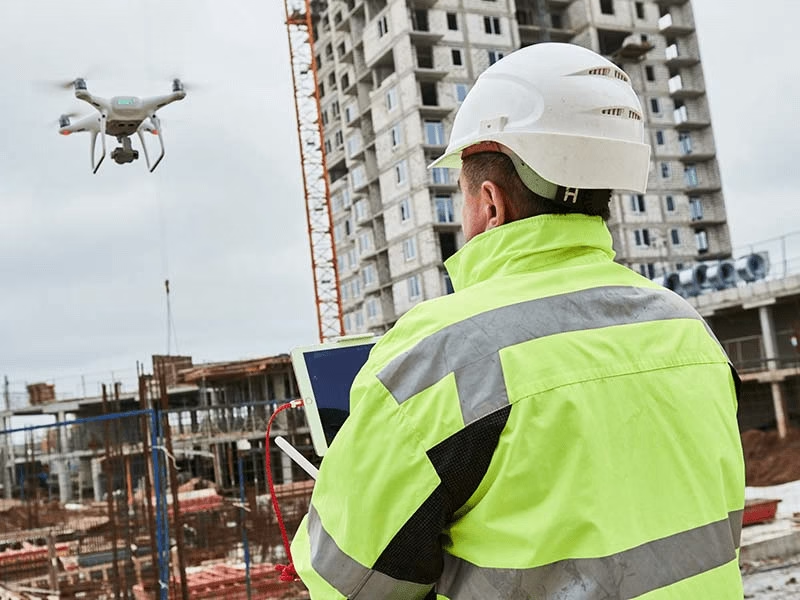
Think of it like a high-tech printer. The process of creating the document is ‘printing’ (our 3D Laser Scanning), but the technology that places the ink on the page is ‘inkjet’ (the Lidar technology). You can’t have one without the other.
Or consider your smartphone. Taking a photo is the process. The camera sensor is the technology. You wouldn’t say “I’m going to camera sensor this sunset”—you’d say you’re going to photograph it.
Similarly, when we at Terrain Surveys talk about performing a 3D laser scan, we’re describing the service we provide. The state-of-the-art equipment we use to deliver this service is powered by Lidar technology.
So when you hire us for a survey, you’re getting the complete 3D laser scanning service—not just the raw technology, but the expertise to use it effectively and transform the data into exactly what you need.
The Terrain Surveys Commitment
Since our founding in 2004, we’ve been committed to excellence. That means investing in the latest technology to ensure we deliver the best results for every client, regardless of project size or complexity.
Our investment in advanced 3D laser scanning equipment means we can work more efficiently and safely on-site. Less time on your property means less disruption to your daily operations. The technology also allows us to access and measure areas that might be dangerous or impossible to reach with traditional methods.
But technology is only part of the equation.
Our team’s expertise transforms raw point cloud data into the exact deliverables you need. Whether that’s 2D CAD drawings, 3D BIM models, or topographical surveys, we ensure the final product matches your requirements perfectly. Our accreditations with professional bodies like CICES aren’t just badges—they’re your guarantee of quality and professionalism.
We understand that every project is unique. A listed building renovation requires a different approach than a new housing development. A homeowner needs different deliverables than a structural engineer. That’s why we tailor our service to your specific needs, not the other way round.
Making the Right Choice for Your Project
So, is there a difference between Lidar and 3D laser scanning?
Yes. Lidar is the ‘how’, and 3D laser scanning is the ‘what’.
But what truly matters is the result: incredibly detailed and accurate data that provides certainty for your project.
The combination of cutting-edge Lidar technology and our two decades of surveying expertise means you’re getting more than just measurements. You’re getting confidence. You’re getting efficiency. You’re getting a partner who understands that behind every survey is a project that matters to someone.
If you’d like some free, professional advice on what your project needs, our expert team is here to help. We’ll discuss your requirements, explain your options, and provide a clear, no-obligation quote.
Contact us today for a free, no-obligation quote.
Because when it comes to your project, precision isn’t just important—it’s everything.


