
Here is something that surprises a lot of people.
You can spend months on a planning application. You prepare drawings, get consultants on board, and organise everything meticulously. Yet, it can still get delayed.
Not because of a structural issue. Not because of a neighbour’s objection.
Because you used the wrong map.
I have seen it happen more times than I would like to admit. Over my years directing projects at Terrain Surveys, incorrect map scales and unsuitable OS products have held up planning applications that were otherwise perfectly sound. It is a frustrating and entirely avoidable problem.
The thing is, Ordnance Survey – the national mapping agency for Great Britain – offers a whole range of products and scales. If you do not know the difference between them, it is genuinely easy to pick the wrong one.
Whether you are a homeowner planning a rear extension, an architect working on a housing scheme, or a facilities manager trying to keep estate records current, this guide will tell you which type of OS map is typically used at each stage. Crucially, it will also explain where OS mapping stops being useful and where a proper survey becomes essential.
Let us get into it.
The Golden Rules of Planning Applications
The Map Requirements You Cannot Ignore
If you are submitting a planning application in the UK, there are two maps you will almost certainly need. These are not optional extras. Local Planning Authorities (LPAs) require them as part of a valid application.
Get them wrong, and your application will not just be delayed. It may be invalidated entirely. For the most up-to-date national guidelines, you can always check the Planning Portal, but the core rules remain consistent across the board. It is worth confirming requirements with your specific LPA before submission, as individual authorities can occasionally apply additional stipulations.
The Location Plan
This is the map that shows where your site sits within its wider surroundings.

LPAs are very specific about what they will accept here:
- Urban areas: Must be at 1:1250 scale.
- Rural areas: Must be at 1:2500 scale.
It needs to show your proposed site outlined with a red line around the site boundary. If you own or control any additional land nearby, that gets a blue line.
Critically, the map must also show at least two named roads and the surrounding buildings. This gives the planning officer enough context to understand exactly where your development sits.
The Site Plan (Block Plan)
Where the Location Plan shows the big picture, the Site Plan zooms in.
This is typically required at either 1:200 or 1:500 scale. It shows the proposed development in relation to your property boundaries and any existing buildings on site.
Think of it this way. The Location Plan tells the LPA where your project is. The Site Plan tells them what you are doing and how it relates to the immediate surroundings.
A Quick Word on Getting This Right
These requirements are not suggestions. They are a strict checklist. An incorrectly scaled map or a missing red line boundary is enough to get an application returned before anyone has even looked at the merits of your scheme.
Which OS Map Product Do You Need?
Not all OS maps are created equal. The product you need depends entirely on what stage your project is at and what you are trying to achieve.
Here is a straightforward breakdown.
Planning Applications: Location Plans and Site Plans
For most planning applications, the OS mapping requirement is quite simple. You need the correct Location Plan and, usually, a Site Plan at the required scale.
At this stage, the purpose of the OS map is to provide context for the application. It helps identify the site and show it in relation to the surrounding area. That is what it is for.
What it is not for is detailed design or accurate measurement.
That distinction matters, because people often assume that an OS-based plan can double up as an accurate design drawing. It cannot.
Feasibility Stage: Wider Context Mapping
There are occasions when OS mapping is useful at a very early feasibility stage, before a client commits to spending money on full surveys and detailed design work.
At that point, a broader map product can help someone understand the surrounding area, site context, access, or constraints at a high level.
But this is usually before our involvement. Once a project moves beyond early feasibility, an accurate measured survey should be commissioned and treated as the proper base information to work from.
Facilities Managers: Base Information for Estate Records
Managing a large estate requires a different approach to mapping. This applies to hospitals, university campuses, or complexes of commercial buildings.
For facilities management, OS-based mapping can still be useful as background or reference information. It can help provide a broad base layer for estate records, especially when combined with measured survey data and other verified information.
The important point is that it should not be treated as survey-grade data.
The Crucial Difference Between an OS Map and a Topographical Survey
When an OS Map Is Not Enough
Here is where a lot of projects run into trouble.
OS maps can be useful for planning submissions, early-stage context, and general reference. But there is a fundamental limitation that catches people out, often at exactly the wrong moment in a project.
OS maps are indicative only. They are not used for planning accuracy, detailed design work, or precise measurement.
That is why we do not actively check OS plans against surveys as a service in itself. Discrepancies are expected. An OS plan and a measured survey will never match exactly, and no experienced professional would expect them to.
This is especially relevant when clients refer to title plans or historic deed plans. These are often supplied only as PDFs as part of land or property purchase documents. In that format, accurate measurements cannot be taken from them either. They may outline an area of interest, but they are not accurate design documents.
For private clients, that can sometimes come as a surprise. For architects, designers, and planners, it usually does not. In our experience, credible professionals do not base detailed plans or designs solely on OS plans, because they know the limitations.
What Is Missing From an OS Map?
To be specific, here is what OS data will not reliably give you for design purposes:
- Precise spot levels and contours
- Accurate positions of drainage and utility features
- Detailed tree positions, canopy spread, and trunk locations
- Minor but critical site features such as walls, fences, kerb lines, and subtle level changes
- Survey-grade dimensions and positions suitable for detailed design or setting out
An OS plan may help identify the site. It may even show a broad outline of what is there.
But it is not an accurate representation of the site as built.
The Role of a Topographical Survey
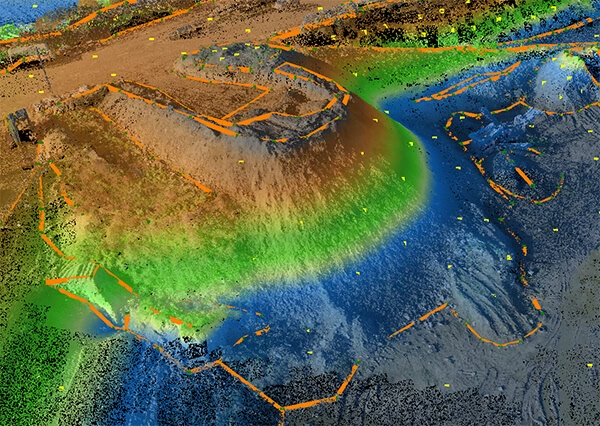
This is where a full topographical survey comes in. It is why, once a project moves beyond feasibility and into design, a proper survey should become the base point for the work.
At Terrain Surveys, we do not treat OS mapping as something to be checked for accuracy and corrected line by line. The inaccuracies are already known and expected. Instead, we survey the site itself and produce the accurate information the design team actually needs.

We measure exact spot levels across the site. We locate utility covers, drainage features, trees, boundaries, buildings, and changes in level. We capture the real-world conditions as they exist on the ground.
To achieve this level of accuracy, we use a combination of total station, GPS, and optical level and staff. This allows us to establish robust survey control and capture the site features with the precision that design and construction work demands.
The result is a fully measured, up-to-date dataset that can be relied upon for detailed design.
That is the key difference.
An OS plan may be enough to support the planning process at the right stage. A topographical survey provides the accurate base information needed to move a project forward properly.
Do You Actually Need One?
Not every project does. Here is a rough guide:
- Planning application for a small extension: An OS-based location plan and site plan may be sufficient for the application itself.
- Early feasibility review: OS mapping may be useful for broad context before any money is committed.
- Architect starting detailed design: Yes, a topographical survey should be commissioned.
- Engineer producing drainage or structural designs: Yes, without question.
- New build residential or commercial project: Yes, an accurate measured survey should form the base information.
- Any project relying on accurate dimensions, levels, or boundary detail: Yes.
Across the many surveys we have carried out, the clearest dividing line is simple: if the project is moving into real design, technical coordination, or construction planning, OS mapping is not enough on its own.
If you are not sure which side of the line your project falls on, that is exactly the kind of question we are happy to answer.
Conclusion
Getting It Right From the Start
Let us bring this together.
Choosing the right OS map is not complicated once you know what you are looking for. For most planning applications, you will need a 1:1250 Location Plan for urban sites or a 1:2500 one for rural sites. Your red line boundary must be clearly marked, and at least two named roads must be visible. Your Site Plan usually follows at 1:200 or 1:500.
That is often enough to satisfy the planning mapping requirement.
But this is where many people blur two completely different things: a planning map and an accurate survey.
OS maps are useful for identification, context, and sometimes very early feasibility thinking. They are not accurate enough for detailed design, and they should not be used as the sole basis for design work. Title plans and historic OS-based documents are especially prone to being misunderstood in this respect, particularly when they are only available in PDF form and people assume measurements can be taken from them. They cannot be relied on that way.
Once a project moves beyond feasibility and into detailed design, the right approach is not to compare an OS plan against the site and try to reconcile the differences. The right approach is to commission an accurate topographical survey and use that as the base point for the work.
That is when you need a topographical survey.
We Are Here to Help – No Obligation
At Terrain Surveys, we work with architects, developers, engineers, facilities managers, and homeowners every day. We know what kind of information different projects require, and just as importantly, what kind of information they should not rely on.
We are happy to give straightforward advice – even if the answer is simply that an OS-based planning plan is all you need at this stage.
We offer free professional advice and free, no-obligation quotes. Our job is to make sure you have the right information for your project, whatever that turns out to be.
If you are unsure whether your project needs a simple planning map or a full topographical survey, do not guess. Get in touch with our team and we will tell you exactly what you need, and why.
Do not leave your project to chance. Contact Terrain Surveys today for free professional advice and a no-obligation quote to ensure your project starts on solid ground.